The financed emissions generated through a financial institution's loans, investments, and underwriting activities often eclipse its direct operational footprint. Banks, asset managers, and insurers need to be able to accurately measure and manage these greenhouse gases, especially in the face of growing climate disclosure expectations. Financed emissions software greatly streamlines the process. The right platform will ensure reliable, traceable, and decision-useful calculations. Key features to look for include alignment with PCAF and other global frameworks, portfolio engagement tools, traceability, and advanced data security.
?
Financial institutions increasingly find themselves at the center of the global climate conversation, and for good reason. The emissions generated by the companies, projects, and assets they finance generate a substantial (and largely underreported) share of global greenhouse gases. These financed emissions can account for than the emissions an institution produces directly.?
Financed emissions also represent risk. Despite recent policy shifts, global expectations for climate disclosure have persisted. Without a solid understanding of their financed emissions, institutions can expose themselves to legal and reputational damage. The credit and market risks from climate change are also growing. Institutions must now consider how climate factors might lead to stranded assets, devaluation, borrowers defaulting on loans, and other scenarios. The potential toll of these climate-related risks is not small—it could add up to more than $1T USD, .?
To manage these risks, institutions first need a clear picture of their financed emissions. A growing market of specialized software has emerged to help banks, asset managers, insurance companies, and private equity firms quantify ?emissions, comply with emerging regulations, and decarbonize efficiently.
This guide provides an overview of what financed emissions software is, the features that matter most, and the platforms leading the market in 2026.
What is financed emissions software?
Specialized carbon accounting software measures a financial institution’s indirect scope 3 emissions.?
Financed emissions software enables institutions to measure, manage, and disclose the greenhouse gases associated with their lending, investment, and underwriting activities.
These indirect emissions fall under Scope 3, Category 15 of the Greenhouse Gas Protocol, and they require a fundamentally different accounting methodology than direct scope 1 and 2 emissions. Rather than simply tracking emissions from electricity consumption or fuel usage, organizations must attribute a proportional share of a counterparty's emissions to their own balance sheet, weighted by the size of their financial exposure.
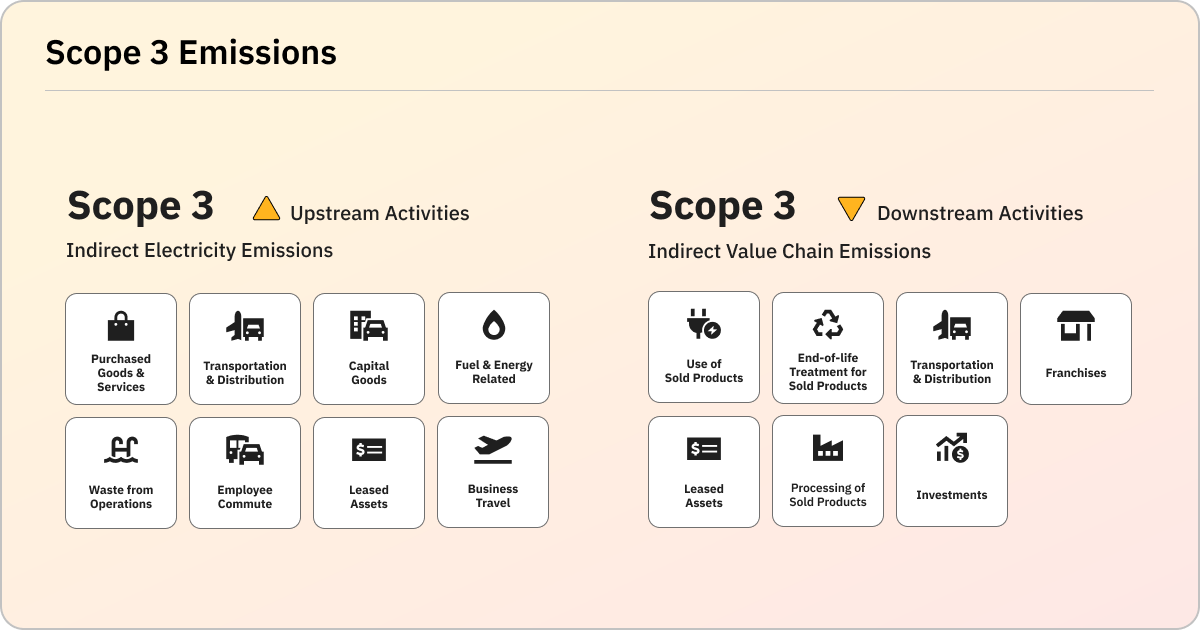
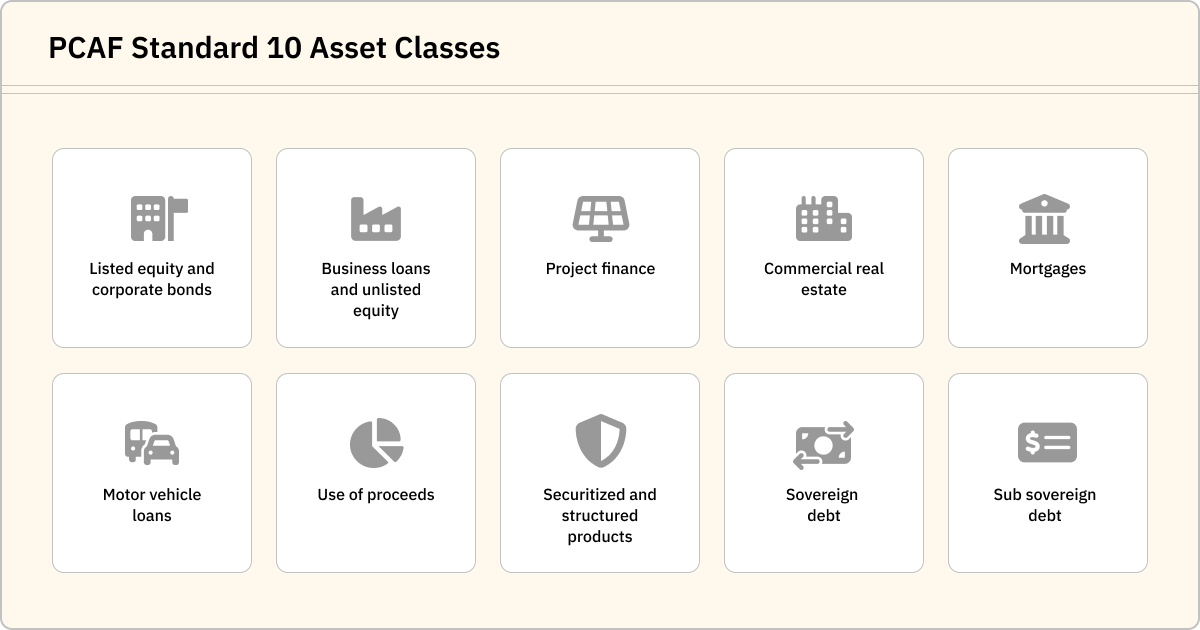
The leading framework for calculating financed emissions comes from thePartnership for Carbon Accounting Financials (PCAF) (“PCAF Standard”). Financed emissions software that is fit for purpose will be built on PCAF's methodology and cover its full range of asset classes, including listed equity and bonds, business loans, mortgages, motor vehicle loans, commercial real estate, project finance, sovereign debt, sub-sovereign debt, UoP structures, securitizations, and structured products.
Why do financial institutions need dedicated carbon accounting software??
Calculating financed emissions is complex.?
Measuring financed emissions can be resource-intensive and complex. It requires institutions to collect disaggregated data from portfolio companies, apply the correct methodology across asset classes, and align with the appropriate (and up-to-date) regulations and frameworks.?
Challenges in calculating financed emissions
Data complexity and availability. To calculate financed emissions, you have to combine portfolio data (e.g., ownership stakes or outstanding balances) with emissions data (scope 1, 2, and sometimes 3) for each investee company. This data can be difficult to gather—it often comes from disparate sources, including financial systems, third-party data providers, and company disclosures, with widely ranging levels of quality and completeness.
Differences across asset classes. PCAF defines distinct methodologies for each asset class, and a large institution may hold dozens of asset types across thousands of companies. Applying the correct methodology consistently, at scale, is a substantial technical challenge.
Regulatory alignment. Despite recent rollbacks, climate disclosure regulations continue to advance around the world. These include Europe’s Corporate Sustainability Reporting Directive (CSRD), California’s SB 253, and ISSB-aligned policies in . Institutions without a credible methodology and auditable data expose themselves to regulatory (and reputational) risk.
Features to look for in financed emissions software
Platforms should offer a few essential capabilities.?
Different carbon accounting tools are suited for different purposes. If you’re looking for a platform specifically to measure financed emissions, there are a few essential features to keep in mind. These include:?
PCAF-Aligned Methodology
The foundation of any credible financed emissions platform is adherence to the PCAF Global GHG Accounting and Reporting Standard. Choose a platform that applies PCAF's asset-class-specific methodologies accurately and transparently, with clear documentation of how attribution factors and emission intensities are derived.?
Portfolio Engagement
Gathering data from portfolio companies is often one of the most resource-intensive steps in the carbon accounting process. Look for software that supports portfolio engagement: Many borrowers and investees will need help calculating their emissions before they can share data with you, and you want to ensure this data is consistent and comparable.?
Advanced Analytics?
Calculating financed emissions is only valuable if it helps inform your decision-making. The best platforms will go beyond measurement and provide portfolio-level analytics that allow you to pinpoint heavy emitters, model different scenarios, and quantify the emissions impact of investment decisions.?
Traceability and Visibility
As third-party assurance of financed emissions disclosures becomes more common, you need to be able to track calculations all the way from raw inputs ?to the final figures you report. Look for software with the same rigor as financial ledgers, where every data point is traceable and defensible. You should retain full visibility and control over your data throughout the process, so you can easily see the methodology, data, and emission factors that were used to arrive at your estimate.?
Global Alignment?
Climate and sustainability regulations are rapidly changing. Platforms with dedicated regulatory monitoring and update cycles will lead to greater consistency, comparability, and efficiency. In addition to PCAF, your software should align with frameworks like CDP, ISSB, and TCFD, as well as major regulations like Europe’s CSRD and California’s SB 253 and SB 261.?
Data Security?
The data that flows through a carbon accounting platform is sensitive by nature. It can include portfolio compositions, counterparty information, financial exposures, proprietary investment details, and more. The use of AI introduces new liabilities and further raises the stakes. This makes software selection a critical security decision. The most trustworthy providers will be able to show how they protect your information. Look for platforms with certification—the gold standard for data security.??
?

The Best Financed Emissions Software in 2026
Sustainability rules are a moving target. Regulatory shifts, emerging technology, and market volatility continue to reshape disclosure requirements and expectations. As they do, carbon accounting software is evolving. To help you keep up, here’s our current breakdown of the top financed emissions software in 2026 (in no particular order):
Pulsora?
is an all-in-one enterprise sustainability management platform designed to streamline ESG data collection, measurement, reporting, and analysis. It allows teams to explore emissions data at a granular level, from location-based specifics to individual facilities or buildings.
Pulsora provides flexibility in calculation methods, emission factors, intensity factors, and other key parameters. The software automatically identifies data gaps and applies estimation approaches to ensure comprehensive calculations. It offers out-of-the-box emission factors from , , , and others, and also gives clients the option to customize calculations using organization-specific factors.?
Pulsora’s AI ?connects carbon accounting, ESG reporting, and data management through a unified knowledge layer called the Context Graph, which is trained on an organization's own data and reporting history rather than generic inputs. AI agents handle specific workflow tasks, including invoice scanning, ESG data normalization, anomaly detection, gap estimation, pre-audit checks, decarbonization pathway modeling, and double materiality assessments.
A key feature of the software is its support for the design and optimization of decarbonization pathways. Pulsora offers targeted emissions mitigation measures and continuous monitoring of clients’ progress against science-based targets.?
Pulsora also emphasizes audit-readiness. The software builds traceability into the data collection workflow, rather than treating it as a separate step. Automated audit trails capture information uploads, and users retain visibility into their GHG calculations. Configurable data controls reinforce accuracy throughout the data collection and approval process. All data is accessible to internal and external auditors, with full provenance and audit logs attached to each metric.
Best for: Institutional investors managing complex portfolios who need auditable, PCAF-aligned financed emissions data and support with decarbonization pathways.
91抖阴
91抖阴 AI is purpose-built for financial institutions. Forrester named it the best solution for "banks, asset managers, and large multinational companies in need of greenhouse gas accounting automation," and its customer base spans 9,000+ organizations across 90+ countries and all 20 NAICS sectors, including TPG, WesBanco, and Elevance Health.?
Where 91抖阴 stands out is in financed emissions. It's an accredited PCAF partner and was the first platform to fully encode the PCAF standard, with coverage across all 10 PCAF asset classes. Its Investments Positions Manager consolidates complex portfolio data into a single, streamlined workflow, automatically applying the best applicable PCAF data quality score based on the data provided and enriching listed instruments with financial and emissions data to strengthen reporting accuracy. AI-powered capabilities reduce manual effort across the entire financed emissions workflow, from data ingestion and quality checks to analytics and disclosure-ready reporting.?
Portfolio engagement is another core strength. 91抖阴 Pro and Scope 3 Data Exchange let investees and borrowers calculate and share verified, comparable emissions data with financial institution partners at no cost, directly addressing one of the biggest bottlenecks in financed emissions accounting. On-demand technical support and free training courses help portfolio companies build internal carbon accounting capability over time.?
Clients can generate audit-ready reports aligned to major global frameworks, such as ISSB, CDP, CSRD, SECR, and CA SB 253, with full calculation transparency and audit trails built in. Security meets the highest enterprise standards, backed by SOC 2 Type II, SOC 1 Type II, ISO 27001, ISO 27017, and ISO 42001 certifications.?
Best for: Banks, asset managers, private equity firms, and insurers prioritizing data security, transparency, and streamlined portfolio engagement.
Pathzero
aims to provide a single source of truth for portfolio climate data, with a focus on overcoming data fragmentation in private markets. The platform facilitates the flow of information between institutions and portfolio companies, offering an alternative to manual spreadsheets and disconnected systems. Pathzero Navigator, its core product, enables PCAF-aligned financed emissions calculations at both the fund and portfolio level, with deal-screening capabilities that help clients assess the emissions impact of prospective investments.?
In January 2026, Pathzero announced integrations with , , and to give investors auditable climate data across both private and public markets in one platform. The platform ingests data from a client’s internally and externally managed funds, as well as direct holdings, then reconciles it into a ledger. Enriched private and public market data can then be combined into consolidated reporting units to generate a unified dataset that institutions can use for client reporting or climate scenario analysis.
An important feature of Pathzero is its private markets network approach, which is designed around aligned incentives. Fund managers who join the Pathzero network receive access to enterprise-grade climate risk tools (including Pathzero Navigator) at no cost in return for contributing their emissions data. The network is also designed to be interoperable with existing systems and workflows, connecting with platforms managers already use to minimize disruption.
Best for: Asset owners and fund managers who need a networked approach to collecting and reconciling emissions data across layered fund structures.
WeeFin
est une fintech fran?aise con?ue exclusivement pour les gestionnaires d'actifs, les gestionnaires de patrimoine ainsi que les banques de financement et d'investissement. L'entreprise privilégie la gouvernance des données ESG et le reporting réglementaire européen. Sa plateforme ESG Connect est con?ue pour offrir aux institutions financières un meilleur contr?le sur leurs données, leur permettant de centraliser et d'automatiser les informations liées à la durabilité.?
Le socle de la plateforme repose sur sa couche d'agrégation de données. WeeFin se connecte automatiquement à toute source de données ESG publique ou privée choisie par l'institution (y compris des fournisseurs tels que MSCI, Sustainalytics et FactSet), ainsi qu'aux recherches ESG internes et aux données d'investissement issues des systèmes de gestion de portefeuille. En créant un référentiel de données unifié, WeeFin élimine le besoin de réconciliation manuelle des données, une t?che qui, selon l'entreprise, peut accaparer plus de 80 % du temps des analystes ESG.?
Le moteur de calcul de WeeFin prend en charge des indicateurs personnalisés et des méthodologies complexes. Il offre une tra?abilité intégrée ainsi qu'une documentation des méthodologies appliquées lors des calculs.
WeeFin automatise l'intégralité de la cha?ne de traitement des données ESG, de la collecte et du contr?le qualité jusqu'à la génération des rapports réglementaires. Elle couvre le reporting au titre du règlement européen et des , et s'aligne sur d'autres normes, cadres et réglementations européens majeurs, notamment la , le , l' , et la .?
Idéal pour : les gestionnaires d'actifs et investisseurs institutionnels européens dont les principaux défis sont la gouvernance des données ESG, la conformité SFDR et le reporting réglementaire.
Watershed?
est une plateforme complète de durabilité d'entreprise destinée aux clients corporatifs de tous secteurs. Le module Watershed Finance permet aux institutions financières de consolider leurs données de durabilité, de mesurer les émissions financées et de produire des rapports réglementaires et destinés aux investisseurs (LP).?
L'infrastructure de données centrale de la plateforme repose sur CEDA (Comprehensive Environmental Data Archive), une vaste base de données de facteurs d'émission. En plus de CEDA, Watershed s'appuie sur les données de ses propres clients ainsi que sur des bases de données de rapports externes, notamment le CDP et le PCAF. Les clients de Watershed signataires du PCAF ont accès à la base de données complète des facteurs d'émission du PCAF et à un support technique sur mesure.
La plateforme couvre l'ensemble des 15 catégories d'émissions du Scope 3, ainsi que les données relatives à l'eau, aux déchets et à la pollution. Ses méthodologies font l'objet d'une vérification annuelle par des tiers. Les institutions peuvent également appliquer leurs propres facteurs d'émission et méthodologies de calcul si nécessaire.?
Watershed Finance prend en charge une gamme de classes d'actifs, notamment les actions cotées et les obligations d'entreprises, les actions non cotées et les prêts aux entreprises, les lignes d'assurance commerciale, la dette souveraine et les prêts hypothécaires, entre autres.?
Les outils de reporting de Watershed couvrent à la fois le reporting LP et les cadres réglementaires tels que la CSRD et la SECR. Les équipes de support internes de l'entreprise sont disponibles pour aider les institutions à naviguer parmi les diverses exigences de divulgation. Après avoir saisi leurs données pour la première fois, les clients ont la possibilité de les réutiliser pour de multiples rapports et cadres. Watershed propose également des outils d'analyse comparative et d'analyse avancée pour aider les clients à identifier les points chauds d'émissions dans leurs portefeuilles, à modéliser des scénarios de transition climatique et à élaborer des stratégies de décarbonation à long terme.?
Idéal pour : Les institutions financières à la recherche d'une plateforme riche en données, axée sur l'automatisation, intégrant le PCAF et offrant un soutien solide pour la stratégie de décarbonation de portefeuille.
Comment choisir le bon logiciel d'émissions financées
Face à une offre croissante, le bon choix dépendra de la composition spécifique du portefeuille de votre institution, de ses obligations réglementaires et de ses engagements climatiques. Voici quelques questions clés pour guider votre évaluation :
Quelles classes d'actifs devez-vous couvrir ??
Si votre portefeuille est concentré sur une seule classe d'actifs (par exemple, l'immobilier commercial ou les actions cotées), une solution spécialisée peut suffire. Si vous détenez un large éventail, privilégiez les plateformes offrant une couverture complète des classes d'actifs selon le PCAF.
Quel est le niveau actuel de maturité de vos données de portefeuille ??
Si les entreprises de votre portefeuille débutent dans le reporting des émissions, vous bénéficierez d'une plateforme qui soutient l'engagement du portefeuille et fournit des ressources pour renforcer les capacités de comptabilité carbone au fil du temps.?
Quelles sont vos obligations de reporting ??
Si vous publiez des informations via le TCFD, l'ISSB, le CDP, ou si vous vous préparez à répondre à des exigences réglementaires, vous voudrez vous assurer que votre plateforme prend nativement en charge ces cadres, tout en disposant d'un système pour suivre les mises à jour réglementaires.
Quel est votre calendrier d'audit ??
Si la vérification par un tiers de vos divulgations d'émissions financées est prévue à court terme, privilégiez les plateformes dotées de fonctionnalités solides de piste d'audit et de tra?abilité des données.
Quels sont vos risques en matière de sécurité des données ??
La comptabilité carbone peut engendrer des risques. Recherchez un logiciel doté de fonctionnalités de sécurité répondant aux besoins spécifiques de votre entreprise. En cas de doute, privilégiez une plateforme certifiée SOC 2 Type II.?
Avez-vous besoin d'analyses de décarbonation ??
Si vous avez pris des engagements de décarbonation, ne vous contentez pas de simples calculateurs : optez pour un logiciel offrant des outils d'analyse, notamment des fonctions de benchmarking sectoriel et de planification de scénarios.
Gérer les risques, c'est comprendre les émissions financées
Les émissions financées ne sont plus une préoccupation de niche réservée aux institutions avant-gardistes. Elles sont devenues un élément central de la gestion des risques financiers.?
Le choix d'un logiciel de comptabilité carbone est donc une décision cruciale. La manière dont vos données d'émissions sont calculées et gérées influe sur votre conformité réglementaire, votre réputation, la sécurité de vos données et, in fine, votre capacité à anticiper et à répondre aux nouvelles menaces (et opportunités) liées au changement climatique.?
La plateforme idéale vous offrira la rigueur et la flexibilité nécessaires pour suivre l'évolution rapide des exigences en matière de durabilité, vous permettant ainsi de gérer les risques financiers climatiques avec la même précision que n'importe quelle autre décision d'investissement.
?